
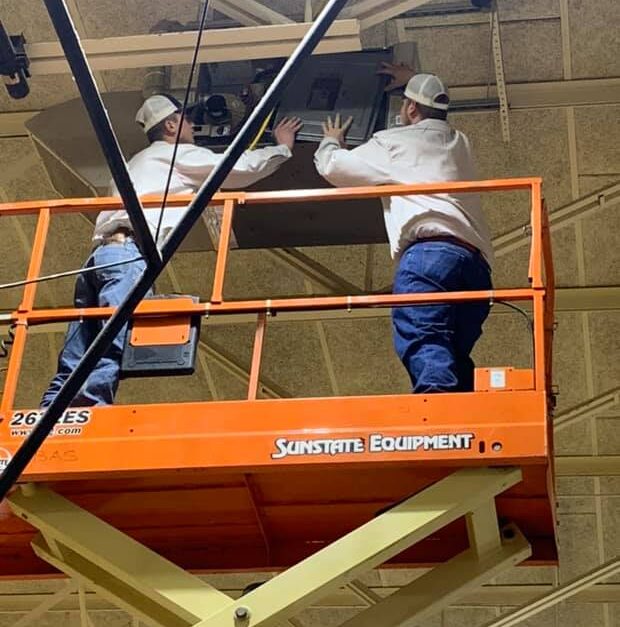
Trying to find Duct Work around Rockdale?
Climate Control A/C & Heating looks after the equipment that keeps buildings comfortable here at home.
Call 512-446-4020 to start the conversation.
The Cooling Season: Why Equipment Works Hard Here
A Rockdale summer stacks hot afternoon after hot afternoon, and the equipment that carries the load is working harder than its owner tends to notice.
Moisture in the air matters as much as the thermometer reading; a cooling system dehumidifies only when the compressor is on and air is moving across the coil.
Right sizing, steady airflow and a clean coil therefore decide how a house feels, whatever the label on the box promises.
The Refrigerant Cycle: What Each Piece Does
Air conditioning is the business of relocating heat; warmth is absorbed in one coil and released in another.
A cold coil indoors takes in heat while the blower keeps air moving; outdoors, a fan pulls air across the condenser coil to shed the load.
Starting and stopping thousands of times a season is hard on switches and capacitors, and the larger parts usually go on to last much longer.
When the House Stops Cooling: Where the Fault Usually Hides
A proper air conditioning repair sorts the symptom from the cause before anything is replaced; three very different faults can feel identical from the thermostat.
If the outdoor unit is silent, power, a breaker and the low-voltage wiring are the first suspects, and each can be tested with a meter in a few minutes.
Ice on the lines almost always means too little air or too little refrigerant; switching the system off and letting it thaw protects the equipment until it can be checked.
Refrigerant is sealed in a loop and does not get used up; a responsible repair locates the leak instead of simply adding more.
Condensate has to leave the house, so a blocked line sends it somewhere less welcome; moisture removed from muggy air adds up to gallons a day.
Clues Your System Is Struggling: Trust Your Senses
The system tends to behave differently well before the day it stops, and the items below are easy to check from inside the house:
- Supply air that feels weak or lukewarm even though the blower sounds normal.
- Loud banging when the compressor starts, particularly at the start of a cycle.
- Constant starting and stopping through the afternoon, even though the thermostat is satisfied.
- Damp spots on the ceiling below the indoor cabinet, especially in humid weather.
Routine Care: What a Maintenance Visit Covers
Routine AC maintenance heads off the kind of failure that arrives on a hot afternoon, and the work centers on airflow, cleanliness and electrical health.
Changing the filter on schedule protects the coil, the blower and the ductwork; the label on the filter and the look of its surface are a reliable guide.
A technician cleans or inspects the outdoor coil, the indoor coil and the condensate drain; temperature drop and refrigerant pressures are measured to show how the loop is behaving.
Repair or Replace: Weighing the Options Honestly
AC replacement becomes a real question when a system is old, repeatedly broken or hard to keep comfortable; the decision belongs to the owner, who deserves the facts.
Some older units run on refrigerant that is now scarce, which affects repair decisions, and that can tip a close decision toward replacement.
Efficiency numbers on new equipment, such as SEER2, give a way to compare models fairly; the benefit grows in houses that rely on cooling much of the year.
Choosing Capacity – Bigger Is Not Better
Air conditioning install quality depends on matching capacity to what the building actually needs; orientation and shading matter as much as floor area.
Too much capacity leads to short cycling, uneven rooms and a clammy feel, and a proper calculation avoids both extremes.
Matched components perform to their design efficiency, while mismatched ones fall short; the owner then gets a walk-through of the thermostat and the filter.
Ducts – What Hides Above the Ceiling
In many houses, the ducts decide whether a new system performs as promised; undersized trunks, kinked runs and open seams all choke the flow.
Ducts that run through a hot attic lose a surprising amount of cooling on the way to the rooms, which can improve comfort without touching the equipment.
When Ducts Need Attention – Reasons and Limits
Duct cleaning is a mechanical job that brushes loose and vacuums out what has collected, and the decision should rest on what is actually in the ducts.
Dirt returns quickly if the filter is poor or the returns leak unfiltered air, and claims about health benefits should be treated skeptically.
The Two-Way Heat Mover – Efficient Most of the Year
Instead of burning fuel, heat pumps pull warmth from outdoor air and carry it inside; in Texas, cold snaps are short, so a heat pump covers most of the heating season.
Auxiliary heat strips back up the heat pump on the coldest mornings, and a technician can check whether the strips are running more than they should.
Burners, Igniters and Flues: How a Furnace Heats a House
The sequence in a gas furnace runs from thermostat call to draft fan, igniter, gas valve and flame proof, and a fault in any one step can stop the whole cycle.
Safe furnace operation depends on clear venting and working carbon monoxide alarms; never ignore an alarm or a smell of gas.
Electric Furnaces and Air Handlers: Simple Equipment, Steady Output
Electric heating systems have no burner, no flue and no combustion byproducts, which keeps the mechanical side straightforward.
Electricity makes heat at a steady rate, but resistance heat uses more power than a heat pump does for the same warmth, and a technician can explain how each option behaves in a mild climate.
Heating Systems of Every Type: What to Do Before the First Freeze
A hard freeze can arrive with little warning, so heating equipment needs to be ready before it is called on; running the heater briefly in fall shows whether it lights, blows warm air and shuts off properly.
Heating systems come in several forms, and the same house may use gas furnaces, heat pumps or electric heating systems, which keeps the work simple to explain and easy to follow.
Hydronic Warmth: How Hydronic Systems Differ
A boiler warms water in a closed loop, and pumps circulate it to the rooms, and the parts, from circulators to expansion tanks, differ from forced-air equipment.
Air in the lines, a stuck valve or a weak pump are common reasons a boiler heats unevenly; water damage can grow quickly.
Cleaner Air Indoors: Starting With Facts
Indoor air quality describes what is floating in the air inside a building, from dust and pollen to odors and humidity; allergy seasons put extra load on filters and ducts.
Choosing a filter means balancing how much it removes against how much resistance it adds; a deeper media cabinet gives better filtering with less restriction.
Commercial air quality depends on ventilation rates, filtration and the upkeep of rooftop equipment; scheduled filter changes and coil cleaning keep these systems honest.
Filters, Purifiers and Their Limits – Useful, With Realistic Goals
Some purifiers capture particles with high-efficiency filters, and others target odors with carbon, and ozone-producing models are better avoided in occupied rooms.
Good results come from a purifier chosen to complement the rest of the system, which is why one device rarely fits every home.
Keeping Coils Clean Between Visits: Understanding the Options
UV lights are a common add-on in humid climates, where the evaporator coil stays wet for months; ask what the lamp targets and how often it needs service.
Fogging a space with antimicrobial mist is a surface treatment, not a cure for a moisture problem, and it works best where the source of moisture has been dealt with.
Fresh Air and Exhaust: Balance in a Humid Climate
Planned ventilation brings in measured amounts of outdoor air and exhausts the stale air, which is where design and service make a real difference.
Ductwork that dumps moisture into an attic can create damage far from the source, and a technician who looks at the surroundings sees more than the unit alone.
Business Climate Control – Planning Around the Business
A commercial AC system is sized for heat from people, lighting and machines as well as sunshine, and when it fails the business feels it quickly.
Condensate drains on rooftops clog with debris, and the water can stain ceilings below, and replacement decisions weigh downtime as well as equipment.
Central Plant Equipment: How They Differ From Packaged Units
A chiller is a large refrigeration machine that chills water for use in many spaces, and they need specialized service knowledge.
Coolers, Freezers and Ice Machines: Walk-Ins, Reach-Ins and More
Refrigeration service covers walk-in coolers, reach-in units, freezers, display cases and ice machines; frost buildup, warm product and constant running all point to trouble.
How Climate Control A/C & Heating Works Through Duct Work across Rockdale
Conversation comes first, because the owner knows the symptoms better than anyone, followed by an explanation of what was found and what the choices are.
Recommendations come with explanations, so choices rest on information rather than pressure, and the owner stays in control of the decision.
Ready When You Are
Call 512-446-4020 to describe what is going on and find the next step.
Closing Thoughts – Equipment, Airflow and Air Quality
Searching for Duct Work in Rockdale usually leads to the same few questions about size, age, airflow and care, and Climate Control A/C & Heating answers questions at 512-446-4020.