
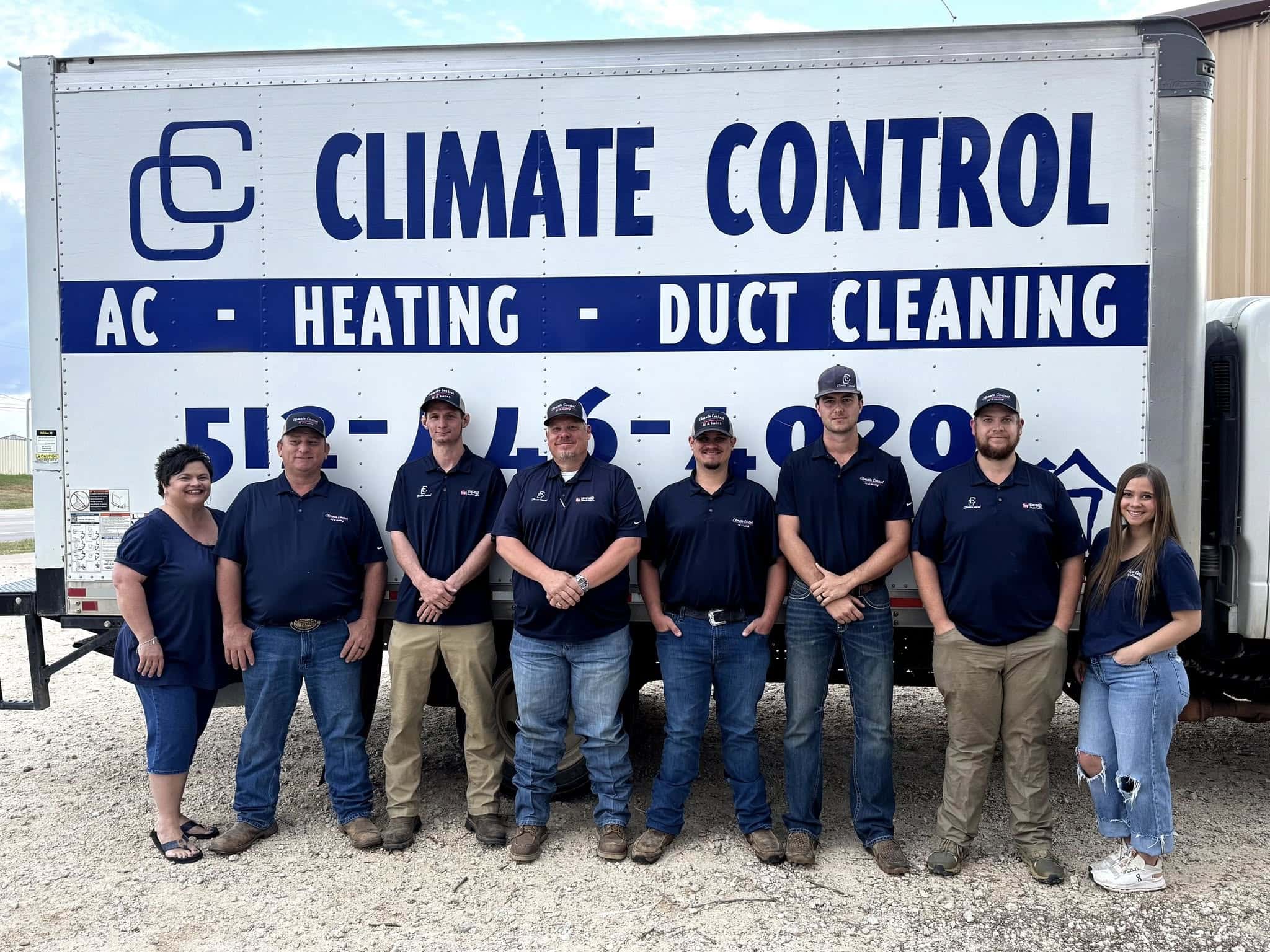
Searching for Commercial Air Quality in Milam County?
Climate Control A/C & Heating supports heating, cooling and indoor comfort close to home.
Phone 512-446-4020 and tell us what you are noticing.
Heat and Humidity – Built for a Long Haul
Summers across Milam County run long, hot and humid; a cooling system here logs far more running hours than one in a mild climate.
Humidity is half of the comfort problem, not an afterthought; a cooling system dehumidifies only when the compressor is on and air is moving across the coil.
Capacity, airflow and cleanliness work together, and a weakness in one shows up as a house that never feels quite right, long before a breakdown ever happens.
How Air Conditioning Works: What Each Piece Does
An air conditioner does not create cold; refrigerant picks up warmth from indoor air and carries it outside.
A cold coil indoors takes in heat while the blower keeps air moving; outdoors, a fan pulls air across the condenser coil to shed the load.
Starting and stopping thousands of times a season is hard on switches and capacitors, and the larger parts usually go on to last much longer.
Service Calls in Hot Weather: Repair Starts With Diagnosis
A thorough air conditioning repair starts with a diagnosis rather than a hunch, and a house that is warm may have an electrical fault, an airflow problem or a refrigerant problem.
If the outdoor unit is silent, power, a breaker and the low-voltage wiring are the first suspects, and they usually repair cleanly because the parts are small.
Ice on the lines almost always means too little air or too little refrigerant; shutting the cooling off is the safest response until someone inspects it.
Low refrigerant means a leak, because the charge stays put when the loop is tight, which is why measuring pressures and temperatures matters more than adding gas.
Condensate has to leave the house, so a blocked line sends it somewhere less welcome, though a stopped system after heavy use is a good moment to check it.
Warning Signs: Trust Your Senses
Air conditioners seldom quit without hints along the way; the list below covers what owners tend to notice:
- Uneven temperatures from room to room while the system runs nonstop.
- A hissing noise near the refrigerant lines, particularly at the start of a cycle.
- An outdoor unit that starts and stops every few minutes, along with a higher electric bill.
- Water around the air handler, sometimes from a dirty coil.
Keeping Equipment Healthy: What a Maintenance Visit Covers
Scheduled air conditioning maintenance gives a technician a look at the system while it still works; the checklist stays short enough to repeat every season.
Dirty filters are the single easiest thing for an owner to handle, and a quick check each month is a good habit through the summer.
The visit usually includes the condenser coil, the evaporator coil and a flush of the drain line; tightening electrical connections is a standard part of the job.
Deciding on a New System: Weighing the Options Honestly
Replacement is worth considering once repairs pile up on equipment that was already aging, with the condition of the compressor and coils weighing heavily.
Some older units run on refrigerant that is now scarce, which affects repair decisions, and newer equipment is built for current refrigerants.
Efficiency numbers on new equipment, such as SEER2, give a way to compare models fairly, which matters most where the system runs for months.
Matching a System to a House – a Calculation, Not a Guess
Proper AC install planning measures the house, the windows, the insulation and the sun exposure; windows, attic insulation and ductwork all change the answer.
A unit that is too large satisfies the thermostat fast and leaves the humidity behind; the right size runs long, steady cycles that dry the air.
Matched components perform to their design efficiency, while mismatched ones fall short, and the installer verifies airflow and charge before leaving the job.
Duct System Basics: Sizing, Sealing and Insulation
The duct system is as much a part of comfort as the unit that feeds it; a house with comfort problems deserves a look at its air paths.
Ducts that run through a hot attic lose a surprising amount of cooling on the way to the rooms, which can improve comfort without touching the equipment.
When Ducts Need Attention: Realistic Expectations
A duct cleaning visit reaches the trunk lines, the branches and the grilles, and the decision should rest on what is actually in the ducts.
Dirt returns quickly if the filter is poor or the returns leak unfiltered air, and claims about health benefits should be treated skeptically.
The Two-Way Heat Mover: How the Technology Works
A heat pump is an air conditioner that can run backward to warm the house; one outdoor unit does the work of two.
A heat pump may call on backup heat during a hard freeze or while defrosting its coil; steam from the outdoor unit during defrost is normal.
Fuel-Fired Warmth: What Owners Should Know
Gas furnaces rely on an igniter, a flame sensor and a gas valve working in sequence, and the sequence is why furnaces need testing before cold weather.
Safe furnace operation depends on clear venting and working carbon monoxide alarms, and homeowners should keep the area around the furnace clear of clutter.
Heating With Electricity: How the Elements Work
An electric furnace passes air over banks of resistance elements that glow when energized; troubleshooting centers on power, controls and the blower motor.
Electricity makes heat at a steady rate, but resistance heat uses more power than a heat pump does for the same warmth, and a technician can explain how each option behaves in a mild climate.
Winter Preparation – Test Before You Need It
A norther can send temperatures tumbling, and heating systems that sat idle all summer must start right up, and a test on a mild day beats a surprise on a freezing one.
Heating services cover igniters and burners on gas units, reversing valves on heat pumps and elements on electric ones, and the safety controls get tested along with the comfort ones.
Boilers – Quiet, Even Heat
Hydronic heating moves heat with water instead of air, which makes for quiet, even warmth, and they are less common in Texas than furnaces and heat pumps.
Air in the lines, a stuck valve or a weak pump are common reasons a boiler heats unevenly; neglected boilers corrode inside, so water quality and venting matter.
Indoor Air Quality – the Part You Cannot See
Air inside a home can carry particles, gases and moisture that the thermostat never shows, and in Texas, cedar pollen and spring dust can find their way inside.
Filter grade matters, but a very dense filter in the wrong system can choke the airflow; a deeper media cabinet gives better filtering with less restriction.
Businesses face their own air issues, from shared air handlers to customers coming and going all day, and a maintenance plan fits the building's size and hours.
Purifiers – Whole-Home or Single Room
Whole-home purifiers treat air as it passes through the system, while portable ones clean a single space; a device that makes bold promises deserves a second look.
Buying a purifier without fixing a moisture problem treats a symptom and misses the cause; a technician looks at the system before recommending a device.
Light and Mist Treatments: What They Do and What They Do Not
Ultraviolet lamps near the coil are meant to keep it cleaner by discouraging growth on damp surfaces, and a technician can explain which kind fits a given air handler.
Antimicrobial mist is a liquid treatment applied to coils, ducts or surfaces to discourage growth; the product and method should be explained in advance.
Ventilation Done Right: the Case for Planned Airflow
Ventilating also removes moisture from kitchens and baths before it settles into the structure; an energy recovery ventilator can trade heat and moisture between the two airstreams.
Attic ventilation is a separate matter, but it affects how hard the cooling system works; the equipment, the envelope and the airflow work as a team.
Cooling for Shops, Offices and Buildings: Comfort That Supports the Work
A commercial AC system is sized for heat from people, lighting and machines as well as sunshine, and filters, belts, coils and drains are the usual checklist items.
Control settings, schedules and thermostats on commercial systems deserve a look when comfort complaints begin, and a technician can map out options on site.
Chiller Systems for Larger Buildings – Water Carries the Cold
Instead of cooling air directly, chiller systems cool a water loop that serves coils across the property, and they need specialized service knowledge.
Commercial Refrigeration: Temperature Is the Whole Job
A refrigeration problem is often found in the condenser, the defrost control or a worn door gasket, and temperature drift is the warning sign to act on.
How Climate Control A/C & Heating Thinks About Commercial Air Quality throughout Milam County
The technician asks what changed, what is happening and how long it has been going on; readings replace guesses, and the findings are explained in plain language.
A repair, a tune-up and a replacement are each described for what they are and what they involve, and the owner stays in control of the decision.
Start With a Conversation
Phone 512-446-4020 to set up a visit or talk through your options.
Closing Thoughts: Small Habits, Big Difference
Equipment, ducts and air quality are connected, so a question about Commercial Air Quality is rarely a stand-alone one, and Climate Control A/C & Heating is ready to help with it.